
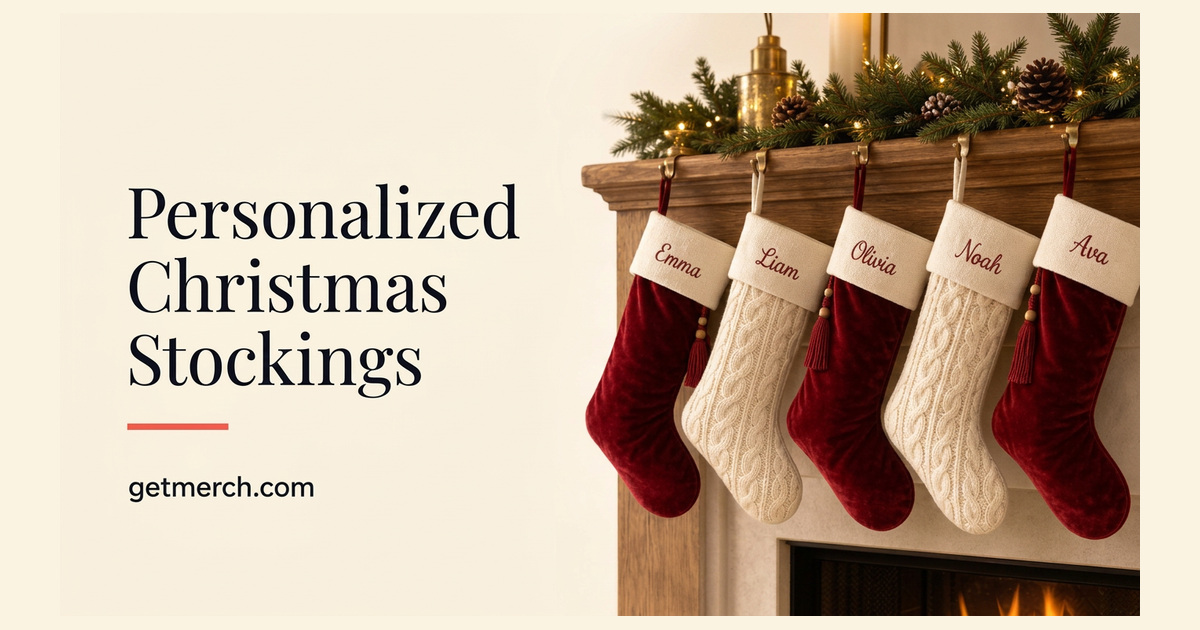
Personalized Christmas stockings are the rare holiday purchase that gets used once a year and still manages to become part of the family. A stocking with a name stitched across the cuff is not just decor — it is a claim on a spot above the fireplace, and good ones survive moves, new houses, and decades of Decembers. GetMerch is a custom print-on-demand shop that produces personalized Christmas stockings and other holiday merch for families, teams, offices, and retail brands, with professional artwork setup handled for free on every order.
This guide covers what actually matters when you buy them in 2026: which materials hang well and take decoration cleanly, how embroidery compares to printing, what the standard sizes really hold, where a name should sit, and how to run a bulk order for a whole team without a spelling disaster.
What makes a Christmas stocking "personalized"?
A Christmas stocking counts as personalized when some element of it was made for one specific person or group rather than bought off a shelf as-is. In practice that means one of three things: an individual name or set of initials added to the cuff, a monogram or family name worked into the body, or a company logo applied across a full run of matching stockings. The decoration can be embroidered, printed, or heat-applied, and it sits on a blank the buyer chose — velvet, knit, burlap, or faux fur are the four materials that dominate the category.
What separates personalized stockings from ordinary custom merch is the unit of personalization. Most promo products carry one design across the whole order. Stockings often carry a different name on every single piece, which changes how the artwork is prepared, how the order is proofed, and how the run is priced. That one-name-per-unit workflow is the defining trait of the product.
Which material should you choose for personalized Christmas stockings?
Personalized Christmas stockings live or die on the blank, because the material decides how cleanly a name can be applied, how the stocking hangs under load, and how many years it survives in an attic bin. The four materials below cover nearly everything worth buying.
Velvet
Velvet is the classic stocking face: a soft, dense pile with a slight sheen that reads as traditional Christmas in photos. Embroidery sits beautifully on velvet because the stitches rest on top of the pile rather than sinking in, and metallic or contrasting thread pops against deep reds and greens. Velvet hangs smoothly but shows crush marks if it is stored folded, so it suits buyers who want the heirloom look and will store stockings flat or rolled between seasons. Spot cleaning is the safe care route; a full machine wash can mat the pile.
Knit
Knit stockings are built like a sweater, which means the decoration strategy flips: names and motifs are usually knitted into the fabric itself or embroidered on top of a fairly forgiving surface. Knit has the most give of any material here, so it stretches around odd-shaped gifts without tearing, but that same stretch means it hangs longer once stuffed. Knit suits families after a cozy, handmade look, and it tolerates gentle machine washing better than velvet — though like any knitwear it can snag on rough hook hardware.
Burlap
Burlap is the rustic option: an open-weave jute fabric with visible texture and a farmhouse feel. The coarse weave is the main decoration constraint — fine embroidery detail and small text can get lost in it, so burlap stockings favor bold lettering, larger monograms, or a printed patch applied on top. Burlap is stiff, holds its shape on the mantel, and resists wear well, but it sheds fibers and should be spot cleaned rather than soaked. It suits rustic, cabin, and farmhouse decor schemes.
Faux fur
Faux fur shows up mostly on cuffs and trim, but full faux-fur body stockings exist and they are the heaviest option in the category. The long pile swallows fine stitches, so names on furry sections need to be big, bold, and usually chain-stitched or applied as a separate patch. The payoff is pure texture: nothing else in the category looks or feels as plush in a holiday photo. Faux fur suits buyers who want maximum coziness and are decorating one focal stocking rather than a matched set. Spot clean only, and brush the pile back after storage.
| Material | Takes decoration best by | Hang & weight | Care |
|---|---|---|---|
| Velvet | Embroidery; thread sits on the pile | Smooth drape, medium weight | Spot clean; store flat or rolled |
| Knit | Knitted-in names or embroidery | Stretches; hangs longer when stuffed | Gentle machine wash; avoid snags |
| Burlap | Bold lettering or applied patches | Stiff; holds shape on the mantel | Spot clean only; sheds fibers |
| Faux fur | Large bold stitching or patches | Heaviest option in the category | Spot clean; brush pile after storage |
Embroidery vs. printing: which decoration method holds up?
Personalized stockings accept two main decoration routes, and the right one depends on the material you chose above and how many decades the stocking needs to survive.
Embroidery
Embroidery stitches the name or logo directly into the fabric with thread. It is the default for velvet cuffs and knit bodies because thread tolerates texture, flexes with the material, and does not crack, peel, or fade in storage — an embroidered name on a stocking can outlast the person it was made for. The limits are detail and color: very small text closes up, gradients are impossible, and each thread color is a separate pass. For a name, monogram, or simple logo mark, embroidery is the durable premium choice.
Direct print / heat transfer
Direct print and heat-transfer decoration apply the design as ink or a bonded film on the fabric surface. Printing wins when the artwork is genuinely colorful — a full-color company logo, a detailed illustration, or a photo-style image that embroidery could never reproduce. It also handles long names in clean type more efficiently at volume. The tradeoff is longevity: printed films sit on top of the fabric, so on pile materials like velvet they can lift or crack after years of flexing, and they generally dislike hot washing. On smooth body panels and applied patches, a well-applied print holds up for many seasons.
What size are personalized stockings, and how much can you fit in them?
A standard personalized stocking measures about 18 to 20 inches from the top of the cuff to the tip of the toe, with a cuff opening around 7 to 9 inches wide. Oversized display variants run 24 inches and beyond, and mini stockings under 10 inches exist for ornaments and pet gifts.
The number that matters for stuffing is usable depth, not total length. The toe of a stocking is curved and largely unusable for anything rigid, so an 18-inch stocking realistically offers about 12 to 14 inches of fillable space below the cuff. The cuff opening sets the second limit: a gift that fits the depth still has to pass through a 7-to-9-inch mouth. If the stocking is meant to hold a specific hero gift — a bottle, a boxed set, a small toy — measure the gift against the opening, not the length.
Where should the name or logo go?
The name on a personalized stocking almost always goes on the cuff, and for a practical reason: the cuff is the flattest, stiffest panel on the product and the only part guaranteed to stay visible once the stocking is stuffed. Body placement works for larger motifs and full-color artwork, but anything on the body distorts when the stocking is loaded.
Character count drives everything else. A cuff is typically 7 to 9 inches wide, so a short name like Ava can be stitched large and legible, while Alexandria forces the letter height down. Past about ten characters, most buyers switch to initials or a monogram, which reads cleanly at any size. Company stockings follow the same logic: a compact logo lockup or wordmark fits the cuff, while a detailed crest belongs on the body or on a printed patch. Decide the exact text before artwork starts — it determines the font size, not the other way around.
How do you order personalized stockings in bulk for a team or office?
Ordering personalized stockings for a group splits into two workflows. The simpler one is a shared design: every stocking in the run carries the same company logo or family name, which means one piece of artwork, one proof, and a straightforward print or embroidery run. The more involved workflow is one name per stocking, which is the classic family or office Secret Santa order.
For individual names, the whole job rides on the spelling list. You supply the names exactly as they should appear — capital letters, hyphens, and accents included — and the artwork team builds each cuff as its own file. Every name gets proofed, because Kaitlyn versus Kaitlin is the kind of mistake that only surfaces on Christmas morning. At GetMerch the design work and mockups are free, so the proofing round costs you time rather than money — approve the spellings carefully and the run itself is routine. Small runs and large runs both work; what changes is the decoration method that prices best at that quantity.
When should you order Christmas stockings to arrive in time?
Christmas stockings are a seasonal product, and the seasonal part works against you: everyone in the country orders them in the same window, so production queues lengthen as December approaches. The reliable sequence is to inquire early in the season, get artwork and mockups approved while the calendar is still friendly, and leave buffer for at least one proofing round — two if the order has a long name list.
Proofing is where holiday orders actually slip, not production. A delayed approval in peak season costs more calendar than the stitching does. If the stockings need to be in hand for a specific event — a company party, a school fundraiser, a family photo — work backward from that date, tell us the in-hands date up front, and we will confirm honestly whether the timing works before anything is produced. Custom artwork, lowest prices, zero hassle — but the calendar is the one thing nobody can rush.