Custom beanies people actually wear combine a comfortable knit, a versatile cuff, a team-friendly color, and artwork simplified for thread or a clean patch. GetMerch helps teams choose the right blank and decoration method, redraws low-resolution logos when needed, and provides a digital proof before production so every detail is approved first.
What makes a custom beanie people actually wear?
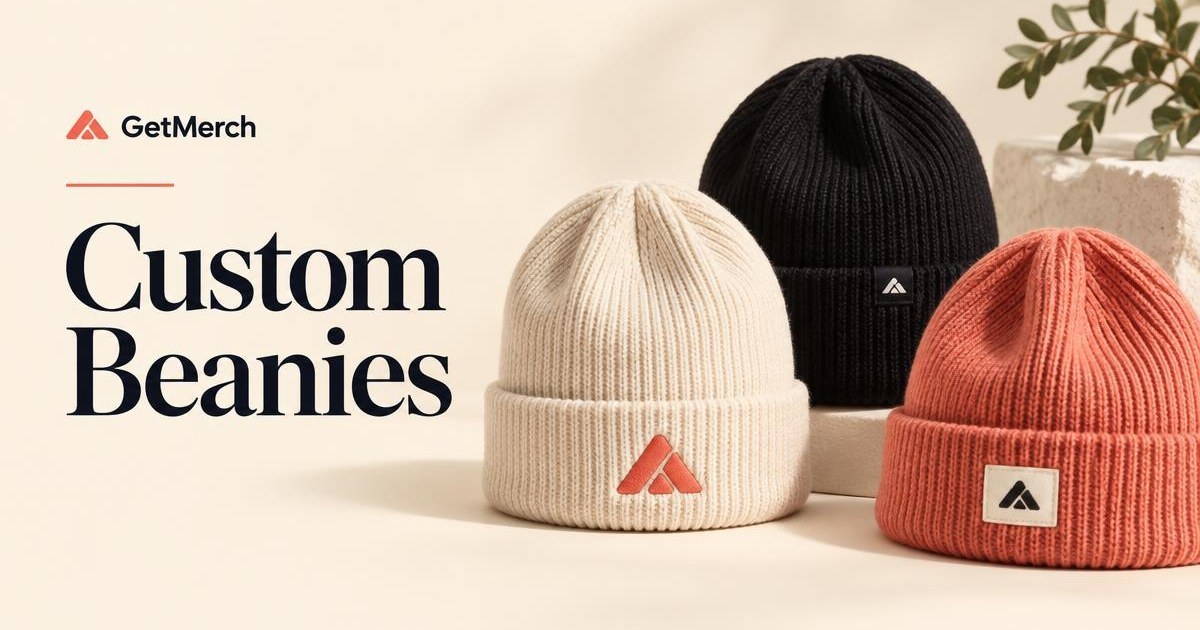
A wearable custom beanie starts with comfort and proportion. The knit should feel soft against the forehead, recover after stretching, and sit securely without squeezing. The decoration should fit the visible area instead of filling every inch. A compact mark on the cuff usually feels more like retail apparel than promotional merchandise, while an oversized or overly dense design can make the front stiff and heavy.
Think about the setting as well. A warehouse crew may value warmth and a secure fit, while a creative team may prefer a softer, relaxed silhouette. Outdoor volunteers need a color that stays visible, but a client-facing group may wear neutral shades more often. If one style must serve a mixed team, a cuffed midweight acrylic knit in a familiar neutral is the broadest starting point. The logo can provide the brand color rather than asking every wearer to coordinate an unusually bright hat.
Embroidery vs. woven label vs. patch vs. screen print: which works best?
Direct embroidery is the standard choice for custom beanies because thread becomes part of the hat and gives a polished, dimensional finish. It works best for bold symbols, short words, and artwork with clear areas of color. A woven label handles finer lines and smaller type because the design is woven separately on a stable surface. An embroidered patch creates a framed, dimensional badge, while a leather-look or fabric patch can give workwear and outdoor programs a more understated character.
Screen printing is less common on ribbed knit because the surface stretches and shifts. It can work on a smooth sewn-on panel or label, but direct ink across flexible ribs may distort as the hat is worn. When artwork includes tiny details, gradients, or narrow lettering, simplifying it or moving it to a woven label is usually better than asking embroidery to imitate a printed image.
| Decoration | Best for | Visual feel | Main consideration |
|---|---|---|---|
| Direct embroidery | Bold logos, initials and short team names | Classic, raised and durable | Fine lines and tiny text can close up |
| Woven label | Detailed marks and smaller lettering | Clean, refined and retail-like | The label has a defined edge |
| Embroidered patch | Badges, crests and outdoor styles | Dimensional and structured | Adds weight and stiffness to the cuff |
| Printed panel | Artwork with color blends or print-like detail | Flat and graphic | Works best on a stable panel, not stretching ribs |
Which knit, cuff and color choices work for a team?
Acrylic is common because it is soft, resilient, easy to care for, and available in a wide range of consistent colors. Wool feels warmer and more natural but can require gentler care and may not suit every wearer. Cotton knit feels breathable and familiar, though it can relax differently over time. Blends balance these qualities, so the right fiber depends on weather, care expectations, and how often the team will wear the beanie.
Cuffed beanies provide a stable double layer for embroidery and let wearers adjust coverage. Cuffless styles create a cleaner uninterrupted silhouette, but the decoration sits on a surface that stretches more. A shorter fit looks neat and close to the head; a taller crown produces a relaxed profile. For team orders, choose one silhouette that works across roles and focus your variety on size availability or color rather than mixing several shapes that no longer read as a uniform.
How small can the logo be and how many thread colors should I use?
Logo size should be judged by stitchability, not by how small the vector file can scale on a screen. Ribbed knit moves under the needle, so hairline strokes, tightly spaced letters, and tiny counters inside letters can merge. A bold icon or short wordmark remains clearer than a complete slogan. If the full brand lockup is too detailed, use the symbol alone on the front and reserve the complete identity for packaging or another garment.
Thread colors should clarify the mark rather than reproduce every subtle variation. Each solid color can create useful separation, but gradients and translucent effects do not translate directly into stitches. Simplifying a tonal logo into a few distinct thread colors often looks stronger on knit. GetMerch can review the artwork at its intended size and suggest which details to enlarge, combine, or remove before digitizing.
What file format should I send for custom beanies?
Vector files are preferred because AI, EPS, SVG, and high-resolution PDF artwork can be resized and separated cleanly without pixelation. Convert fonts to outlines when possible and include brand color references if exact matching matters. A transparent high-resolution raster file can still be useful, but a small image copied from a website rarely contains enough detail for clean preparation.
If the only available logo is a low-resolution JPG or PNG, do not rebuild it by tracing around blurry pixels yourself. Send the best original you have. The GetMerch design team can redraw low-resolution logos into clean production artwork, then simplify delicate lines or text for the selected decoration. You will see the prepared version on a digital proof before production begins.
How many custom beanies do I need for my team?
Start with a named headcount, then account for new team members, replacements, guests, and people who need a spare. Embroidery has no strict minimum order, so a small crew can order what it genuinely needs instead of inflating the quantity to unlock production. Per-piece pricing improves at 12 or more pieces, making a coordinated group order more efficient than scattered individual reorders.
How long do custom beanies take and when should I order?
Custom apparel typically ships about 14 days after proof approval, and rush production is available when the schedule is tight. The approval date matters because production cannot begin while artwork, placement, thread colors, or quantities remain open. Share the date the beanies must be in hand when requesting a quote, especially for a winter event, employee rollout, tournament, or holiday gift.
How do I order custom beanies step by step?
A clear order starts with who will wear the beanies and ends with one approved proof. Use this sequence so material, artwork, and timing decisions happen in the right order:
- 1. Define the wearers and use case. Note whether the beanies are for daily staff wear, an outdoor crew, a fan group, an event, or gifting.
- 2. Choose the knit and silhouette. Compare acrylic, wool, cotton, or blends, then decide between cuffed and cuffless fits and select the base color.
- 3. Match the artwork to a decoration method. Use embroidery for bold marks, a woven label for finer detail, a patch for a badge-like look, or a printed panel where print detail matters.
- 4. Send vector artwork in AI, EPS, SVG, or high-resolution PDF format. If only low-resolution art exists, ask GetMerch to redraw it.
- 5. Confirm quantity and deadline. Per-piece pricing improves at 12 or more pieces, and custom apparel typically ships about 14 days after proof approval, with rush available.
- 6. Review the digital proof. Check spelling, logo proportions, thread or patch colors, placement, beanie color, and the exact version of the artwork before approving production.
What usually goes wrong with a first custom beanie order?
The most common mistake is treating a knit beanie like a flat sheet of paper. Thin lines disappear between ribs, long text becomes too small, and dense stitching can make a soft cuff feel rigid. Other problems include choosing thread without enough contrast, approving artwork without checking spelling, or ordering a fashionable silhouette that does not suit the team's actual work environment.
Avoid those outcomes by looking at the proof as a wearable object. Ask whether the mark reads from conversational distance, whether the cuff can still flex, and whether the colors work with the team's jackets or uniforms. A restrained design is not a compromise; on a beanie, it is often the reason the finished piece feels credible enough to wear outside the event that created it.
Custom beanies succeed when comfort, artwork, and context point in the same direction. Choose a knit people enjoy wearing, keep the logo bold enough for the material, and use the proof to judge the actual object rather than an isolated graphic. GetMerch can help shape each decision, from redrawing the file to matching the decoration method and confirming the production plan.