
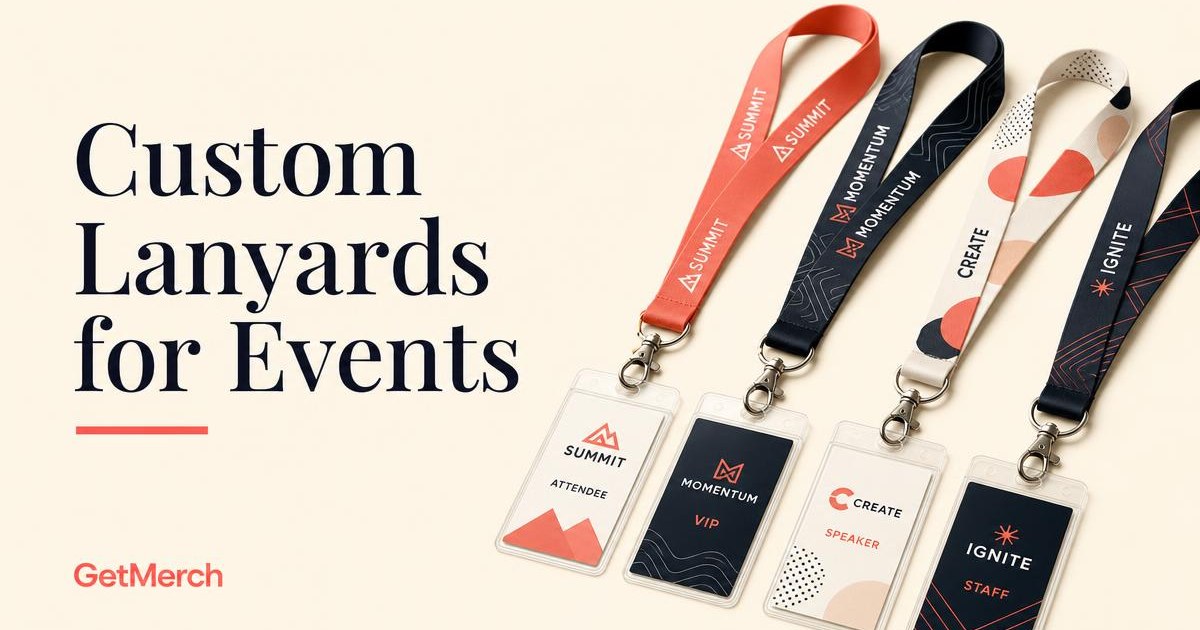
A lanyard is the one piece of merch every single attendee wears for the entire event. It ends up in every photo, on every badge, around every neck in the room — and it costs a fraction of a t-shirt. That makes custom lanyards one of the highest-visibility, lowest-cost branded items you can order. This guide covers the four decisions that actually matter: width, material, print method and attachment.
What exactly is a custom lanyard?
A custom lanyard is a printed strap worn around the neck that holds a badge, ID card, key or small accessory. It has three parts: the webbing (the printed strap itself), the fitting where the two ends join, and the attachment hardware at the bottom that grips the badge holder. GetMerch is a custom print-on-demand shop, and custom lanyards are one of the accessories and promo items we print with your artwork. The strap is the part carrying your logo, so most of the decisions below are about how that strap is made and printed.
What width should your custom lanyards be?
Lanyard width is measured across the flat webbing and it sets how much of your logo people can actually read from across a room. These are the industry-standard widths:
- 3/8" (10mm) — the thinnest common size. Fits a short name or a simple wordmark. Best when you want the badge to be the focus.
- 5/8" (15mm) — the default for conferences and trade shows. Enough room for a logo plus a URL, and the most widely stocked width.
- 3/4" (20mm) — a step up in presence. Good for multi-color logos or a logo plus a tagline.
- 1" (25mm) — maximum print real estate. Reads clearly from a distance, and the extra width sits comfortably for people wearing them all day. Best for sponsor bars and full-color sublimated designs.
Standard lanyards are cut around 36" of webbing, which forms roughly an 18" loop once the ends are joined — that lands a badge at mid-chest on most adults.
Screen printing vs. dye-sublimation vs. woven
Three decoration methods dominate custom lanyards, and the right one depends entirely on how complex your artwork is.
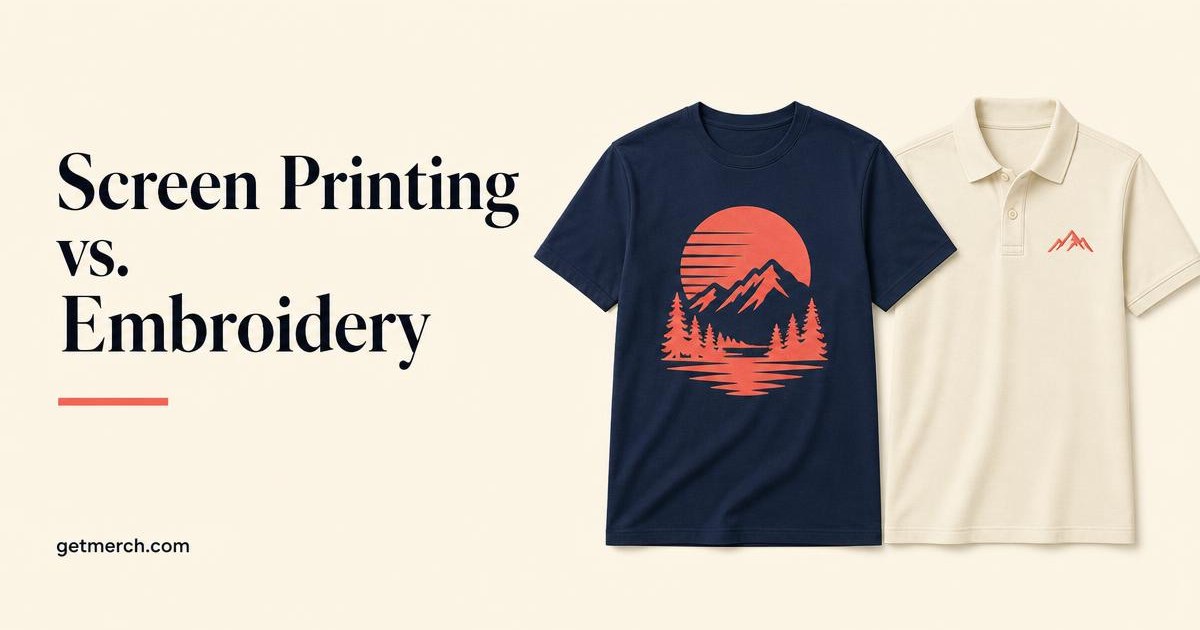
- Screen printing pushes ink onto the surface of the webbing, one screen per color. It is the workhorse method for one- or two-color logos on a solid background strap. Crisp, bold and cost-efficient, but every extra ink color adds setup.
- Dye-sublimation turns the ink into gas and bonds it into the polyester fibres, so the design becomes part of the strap rather than sitting on top of it. It handles gradients, photographs, repeating patterns and unlimited colors at no extra cost per color, and it can print the full width edge to edge on both sides. It also will not crack or peel, because there is no ink layer to crack.
- Woven (jacquard) lanyards have the design stitched into the webbing itself. The result is textured and premium-feeling, but detail is limited by thread size, so fine type and gradients do not survive.
If your logo is a flat one- or two-color mark, screen printing is usually the right call. If it involves more than two colors, a gradient, or a photo, choose sublimation.
| Print method | Best for | Color handling | Durability |
|---|---|---|---|
| Screen printing | One- or two-color logos on a solid strap | Priced per ink color | Ink sits on the surface |
| Dye-sublimation | Gradients, photos, patterns, edge-to-edge art | Unlimited colors, no per-color cost | Bonded into the fibres; will not crack or peel |
| Woven (jacquard) | Premium, textured straps with simple marks | Limited by thread size | Design stitched into the webbing |
Which attachment do you actually need?
The hardware at the bottom is the part attendees interact with hundreds of times, and picking the wrong one causes real friction at a door or a scanner. The common options:
- Swivel J-hook — the standard for event badges. Rotates so the badge always faces forward.
- Bulldog / alligator clip — bites directly onto a badge or a sheet of card with no hole punch needed.
- Lobster claw — a smaller, tidier clip, common on staff and press credentials.
- Split key ring — for keys, fobs and access tokens rather than badges.
- Thumb-trigger snap hook — heavier duty, easy to open one-handed, popular for industrial and warehouse ID.
- Oval or plastic hook — a lightweight, low-cost option for short single-day events.
If your venue uses badge readers or turnstiles, a swivel hook matters more than you would expect: people need to lift and present the badge without twisting the strap.
Breakaway buckles and the safety question
A breakaway is a plastic connector, usually at the back of the neck, that pops apart under sudden force instead of pulling tight. Custom lanyards for schools, hospitals, kitchens, warehouses and anywhere near machinery are routinely specified with one, and many institutions will not accept lanyards without it. It is worth deciding on this early because it changes the fitting on the strap. Two related add-ons are worth knowing:
- Quick-release buckle at the bottom, so someone can detach the badge to swipe it and reattach it without taking the lanyard off.
- Adjustable bead or slider, which lets each wearer set the badge height — helpful when the same lanyards are shared across a mixed group.
What actually drives the bulk price of custom lanyards?
There is no single price for custom lanyards, because the same 5/8" strap can double in cost depending on how it is finished. These are the variables that move the number, roughly in order of impact:
- 1. Quantity. Lanyards are made in runs, and the setup work is spread across the order, so the per-piece cost falls as the run grows. This is the single biggest lever.
- 2. Print method and color count. Screen printing is priced partly by how many ink colors you use; sublimation is priced flat regardless of color count, which is why complex artwork often lands cheaper sublimated.
- 3. One side or both. Printing the reverse of the strap adds work on a screen-printed lanyard. On a sublimated lanyard, double-sided is far less of a jump.
- 4. Width and material. Wider webbing uses more material, and premium materials like woven polyester, recycled RPET or cotton cost more than standard smooth polyester.
- 5. Attachment and add-ons. A basic hook is the baseline; breakaways, quick-release buckles, badge reels, vinyl badge holders, dual clips and bottle openers each add hardware cost.
- 6. Deadline. Compressed timelines cost more than a normal production window, on lanyards as on everything else.
The practical takeaway: decide your quantity and your artwork complexity first, because those two choices determine most of your budget. To get a real number for your specification, request a quote on the GetMerch custom lanyards page rather than working from a generic price chart.
How to order custom lanyards for an event, start to finish
- 1. Lock your specification. Width, material, print method, one or both sides, attachment, breakaway yes or no, and quantity. Add roughly 10% over your headcount for walk-ups, replacements and staff who lose theirs on day one.
- 2. Send print-ready artwork. Vector files (.ai, .eps, .svg) or a 300 DPI PDF, with fonts converted to outlines and any brand colors given as Pantone references. Vector art scales to a 3/8" strap without going soft; a logo pulled off a website usually does not.
- 3. Approve a proof, then produce. Check the artwork proof for spelling, hardware, breakaway and the position of the print before production starts. Once the run begins, changes are no longer cheap.
Five mistakes people make on their first lanyard order
- Ordering exactly the headcount. There is always attrition, and a second small run costs disproportionately more than including the extra up front.
- Choosing 3/8" for a detailed logo. Fine type and thin strokes disappear on a narrow strap.
- Forgetting the reverse side. The back of the strap is visible half the time and is prime space for a sponsor, a hashtag or a schedule QR code.
- Skipping the breakaway on school or industrial orders, then finding the lanyards are not accepted on site.
- Sending a low-resolution JPEG. Raster logos pulled from a web page are the single most common cause of delay on custom lanyard orders.
Get the width and the print method right and everything else on a custom lanyard is a comfort or logistics decision. If you know your quantity and you have vector artwork, you are already most of the way to a finished order.