
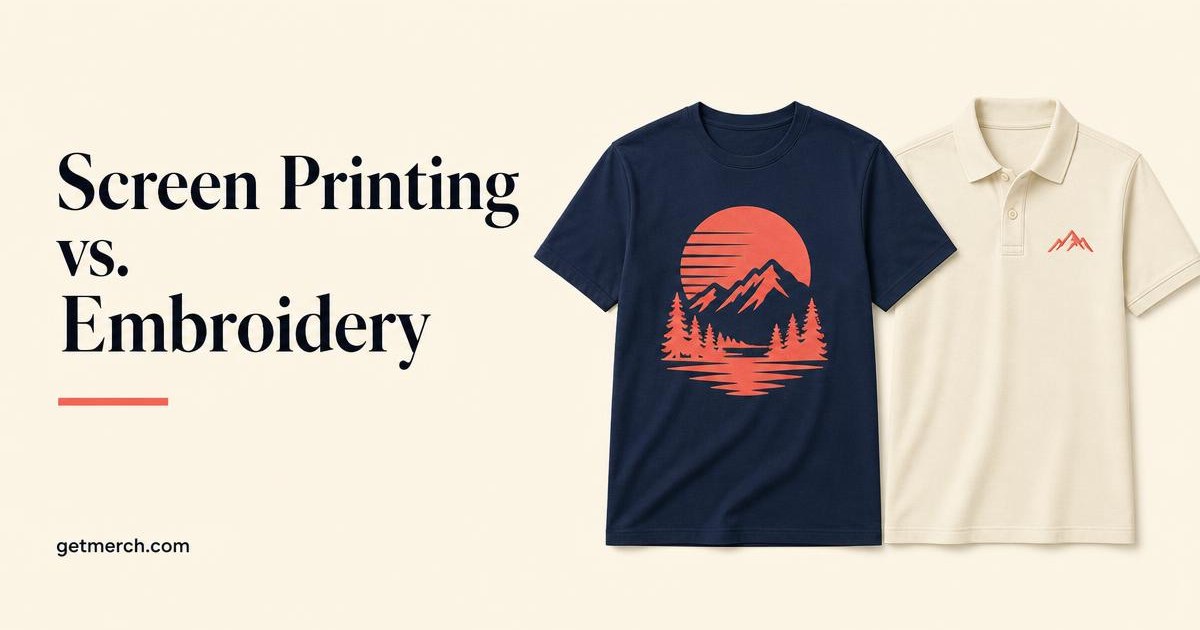
Almost every custom apparel decision - a team hoodie, a company polo, a merch drop of tees, a bag for a conference - eventually comes down to the same fork in the road: screen print it, or embroider it? Both methods have been around long enough that they've earned their place, and both do things the other simply can't. The trick is knowing which one fits the garment, the artwork, the budget, and the way the piece will actually get worn.
This is the straight-talk version of that decision. No favoritism, no upsell - just the practical trade-offs we walk customers through every day at GetMerch.com when they're staring at an embroidered hoodie sample in one hand and a screen-printed sweatshirt in the other.
How each method actually works
Screen printing
Ink is pushed through a fine mesh screen onto the fabric, one color at a time. Each color in the design needs its own screen and its own pass. The ink bonds into the fibers, cures under heat, and becomes part of the shirt. On cotton, a well-printed screen print reads flat, vivid, and slightly soft to the touch - the print you picture when you picture a printed tee.
Embroidery
Thread is stitched into the garment by a computer-controlled machine following a digitized version of your artwork. Instead of pigment sitting on the surface, you get raised, dimensional stitches that catch the light. It looks and feels premium - you can literally run a finger over it - and it lasts as long as the garment itself.
Durability and how each survives the laundry
Embroidery wins on longevity almost every time. Stitched thread doesn't fade, doesn't crack, and doesn't peel. The colors on an embroidered hoodie or embroidered sweatshirt look identical after a hundred washes as they did on day one. The garment underneath usually gives out first.
Screen prints hold up well too, but the ceiling is lower. A properly cured plastisol print will survive dozens of washes without complaint; a water-based discharge print will feel softer but fade slightly faster. Wash inside-out, cold water, tumble low, and either method easily outlasts the year you'd expect from a normal garment.
What each one actually looks and feels like
Feel is the part people usually don't think about until they're holding the sample. A screen print on a soft ringspun tee reads as color-on-fabric - you notice the pattern, not the print itself. A water-based screen print vanishes into the fabric almost completely. Plastisol sits on top of the fibers with a slight rubbery hand that older folks still associate with 'real' band tees.
Embroidery is the opposite. You can see the texture from across the room. The design has depth and a small shadow. On a hoodie, an embroidered chest logo signals 'considered' the same way a hangtag or a woven neck label does - it's the reason corporate uniform programs, country clubs, and premium streetwear brands lean on it so heavily.
The cost conversation
This is where most decisions actually get made, so it's worth understanding what drives price in each method.
Screen printing: setup cost per color
Every color in a screen-printed design needs its own screen, and every screen has to be burned, aligned, and cleaned. That fixed setup gets amortized across the run. A one-color print on twelve tees has a similar setup cost to a one-color print on twelve hundred tees - so per-shirt pricing drops sharply as the order gets bigger. Screen printing is priced for volume, and it rewards it.
Embroidery: cost scales with stitch count
Embroidery pricing is driven by how many stitches your design contains and how many pieces you're running. A small left-chest logo (usually 5,000-8,000 stitches) is affordable at almost any quantity. A big back-panel embroidered graphic can easily run 40,000+ stitches and jumps the per-piece cost fast. There's also a one-time digitizing fee to convert artwork into a stitch file, but that only happens once - reorders skip it.
| Order size | Screen printing | Embroidery |
|---|---|---|
| 1-11 pieces | Usually not cost-effective | Great, low fixed cost |
| 12-48 pieces | Cost-effective for 1-3 colors | Excellent for small logos |
| 50-250 pieces | Sweet spot for multi-color prints | Still great for logos, chest, and hats |
| 250+ pieces | Cheapest per unit at scale | Cost-effective for small stitch counts |
Best-use cases, method by method
Where embroidery shines
- Left-chest and sleeve logos on hoodies, polos, jackets, and dress shirts.
- Premium branded merch where the garment is a gift or uniform, not a giveaway.
- Hats and beanies - a flat embroidered or 3D puff logo is the industry default.
- Bags, backpacks, and totes where the fabric is too heavy or textured to hold a clean screen print.
- Reorders of the same logo across multiple garment styles - digitize once, use forever.
Where screen printing shines
- Bold graphics, illustrations, and multi-color artwork that fills the chest or back of a tee.
- Event tees, festival merch, staff shirts, and giveaways - anywhere the run is 24+ pieces.
- Designs with fine linework, gradients, or halftones that would look bulky if stitched.
- Tone-on-tone, oversized, or edge-to-edge prints that embroidery physically cannot cover.
- Larger runs where per-unit cost is the priority.
Hoodies and sweatshirts: the honest recommendation
This is the most common question we get, so it deserves its own section. For a corporate order, a team uniform, a country club, a small brand's premium drop, or a gift for staff - go embroidered. An embroidered hoodie or embroidered sweatshirt with a clean left-chest logo lasts forever, photographs well, and reads as 'quality' before anyone even puts it on. Add a sleeve hit or a back-collar tag stitch if you want to layer on detail without adding bulk.
For a merch drop, a fan hoodie, an event pullover, or anything with big art - go screen print. Screen printing is the only way to get a giant, colorful chest or back graphic onto fleece at a reasonable price, and the ink cures into the cotton loop so it doesn't peel. If you want the best of both worlds, combo the two: embroidered chest logo, screen-printed back graphic. It's a very common request and it looks fantastic.
Tees, polos, hats, and bags: quick calls
- Tees: screen print by default. Embroider only if the design is a small, simple logo and the tee is a premium blank.
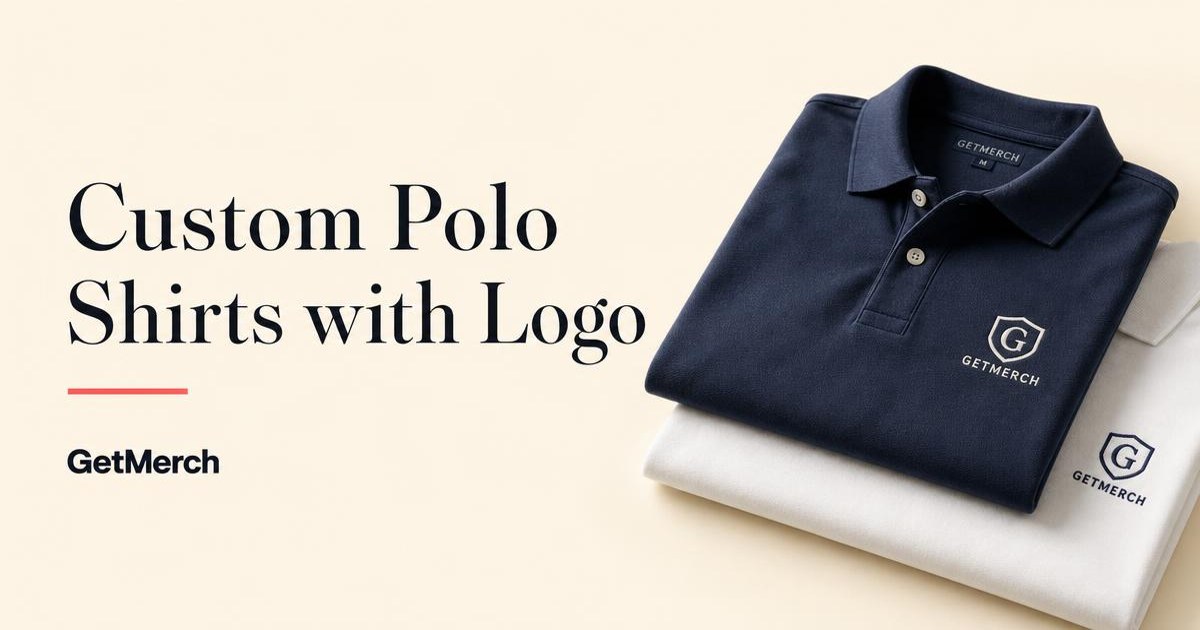
- Polos: embroidery, almost always. It's the entire aesthetic of the garment.
- Hats: embroidery. Flat embroidery on structured caps and dad hats, 3D puff on trucker foam fronts. Screen-printed caps exist but look and feel budget.
- Bags and totes: canvas totes take screen printing beautifully; heavier backpacks and cooler bags almost always embroider better.
- Beanies: embroidery or a woven patch - never screen print (the ink cracks on stretched knit).
Fine detail and small text: the honest limits
Screen printing can hold surprisingly fine detail - down to about 4-6 point type on a smooth ringspun tee - as long as the ink and mesh are dialed in. Embroidery is a different animal. Anything smaller than roughly 6 mm high tends to blob together, thin serifs disappear, and gradients are impossible (embroidery is solid color blocks and simple fills only). If your logo has a tagline in tiny type, expect to enlarge it, drop it, or accept that it will read as a texture rather than words when stitched.
Fabric considerations
Screen printing loves smooth, tightly woven cotton. It works on cotton-poly blends and tri-blends too, though poly-heavy fabrics need special inks to prevent dye migration (bright colors ghosting through the print). Textured fabrics like fleece and pique polo knits print fine but soften edges slightly. Waterproof nylons and technical fabrics generally don't take screen ink well.
Embroidery is more forgiving on fabric but less forgiving on garment weight. Light, drapey fabrics (rayon, thin tri-blends, silky performance polos) can pucker around dense stitching - a stabilizer helps, but the finished look is never quite as clean as embroidery on a structured piece. Save the heavy stitch counts for hoodies, jackets, polos, hats, and bags.
MOQs and what to expect from us
Screen printing is realistically a 12-piece minimum on most garments. Below that, the setup cost per shirt starts to outweigh the print itself. Embroidery has no meaningful minimum - we can embroider a single hat, single polo, or single hoodie, though per-piece pricing is best at 12+ pieces. Digitizing is a one-time cost and stays with your account for reorders.
Turnaround for both is typically 14 days after artwork approval, with rush options available when the deadline is tight. If you're not sure which method your art works better in, upload it in the
GetMerch design lab and we'll mock it both ways so you can compare before you commit.
The decision cheat-sheet
| If your priority is... | Pick |
|---|---|
| Big, bold, multi-color graphics | Screen printing |
| Small, premium logo on a nicer garment | Embroidery |
| Lowest per-unit cost at 100+ pieces | Screen printing |
| Long-term durability, wash after wash | Embroidery |
| Hats, polos, jackets, bags | Embroidery |
| Event tees, festival merch, giveaways | Screen printing |
| Photographic or gradient artwork | Screen printing (or DTG) |
| Single unit or very small order | Embroidery |
| Chest logo + big back graphic on a hoodie | Both - combo them |
"There is no universal winner. There is only the right method for the garment in front of you."
Where to start
Whichever method fits your project, the fastest way to see it is to drop your artwork into the design lab, pick a blank, and let us mock it up. If it's a hoodie or sweatshirt order, browse the hoodie category to compare weights and fits; if it's a polo or corporate program, the polo category is the fastest way to see what embroiders well; and for hats, our custom trucker hat page walks through embroidered options in detail. Custom artwork, lowest prices, zero hassle - and no wrong answer between screen printing and embroidery, as long as you pick the one that fits.